

English
“In the beginning was the Word.” John 1:1Click here to read about our curriculum offer and download our progression maps
At Clifton-upon-Dunsmore Primary School, we passionately believe that literacy and communication are key life skills. Through our English Curriculum, we strive to give our children the necessary tools to be able to communicate effectively and creatively through spoken and written language and to equip them with the skills to become lifelong learners. We encourage children to develop a love of reading and an appreciation for literature in its rich variety by using quality texts and topics that inspire and excite them to become young readers and writers.
The English curriculum is delivered using the National Curriculum English Document (2014). The Early Learning Goals are followed to ensure continuity and progression from the Early Years Foundation stage through to the National Curriculum. Throughout the school, we adopt a mastery approach to English teaching and do not impose any 'glass ceilings' on our pupils: the same high expectations apply to all learners, and where there is evidence that a child, or group of children, are falling behind, we will intervene quickly in order to ensure that they can catch up.
Where appropriate, English units will link to other areas of the primary school curriculum to promote cross-curricular learning, although this will not be forced: our primary objective will be to ensure that learning is focused on high-quality, engaging texts.
Reading
Reading is an important part of the English curriculum in our School. In Reception and in Year 1, our reading is organised through the Little Wandle phonics scheme: each class will be organised into small groups that will read a text that is appropriate to their level of attainment and progress. They will read this text three times in school, focusing on developing their decoding, prosody and comprehension skills. This book will then be sent home so that the child can enjoy and celebrate their achievement in reading with parents or carers. All children in Reception and Year 1 will also have a daily phonics lesson as part of the Little Wandle scheme.
As children progress through Year 2, our expectation is that they will transition from Little Wandle to the Accelerated Reader scheme. This will promote a deeper love of reading by using non-scheme books, with a wide range of texts by some of the best authors. Whilst the majority of pupils will be ready to make this transition in Year 2, some pupils will continue to need the support of the catch-up materials that Little Wandle provides throughout Key Stage 2. Likewise, we recognise that some children in Year 1 and even Reception may be ready to start Accelerated Reader. We always strive to support, challenge and encourage our pupils at their own level, regardless of age or stage.
In order to really value reading, we encourage all of our children to read regularly both in school through dedicated reading time every week and at home. Each parent is given the opportunity to liaise with teachers through reading record books which record when the children have been listened to in School by a member of staff or a volunteer, and at home, and any issues or positives there may be.
Shared reading takes place within English lessons to provide enriching experiences through more challenging texts. Teachers also share stories with the class displaying enthusiasm for reading and setting a positive example as a reader.
The school environment has a big focus on reading and books are readily accessible for everyone.
Writing
At Clifton upon Dunsmore Primary School, we believe that every child can become a confident and successful writer. Our curriculum develops both the technical aspects of writing — including handwriting, spelling, punctuation and grammar — alongside the creativity needed to communicate ideas effectively. Through a carefully sequenced approach, pupils are guided towards becoming independent writers who can achieve their full potential.
Using the ‘I’m a Clever Writer’ approach, children move through a structured journey from spoken language to fluent, purposeful writing. High-quality texts are central to our curriculum, providing inspiration, meaningful contexts and rich vocabulary that support children in developing independence and fluency as writers. By revisiting key genres and refining skills over time, pupils learn to communicate clearly and effectively across the wider curriculum.
“I’m a Clever Writer”
“I’m a Clever Writer” is our whole-school approach to the teaching of writing. It provides children with the knowledge, skills and understanding needed to communicate clearly, accurately and creatively through writing. From early mark-making in EYFS to producing thoughtful and well-structured pieces of writing, pupils are supported at every stage of their development through a clear and progressive framework.
Building Strong Foundations
Strong writing begins with secure early development. In the first stages of learning, children are supported in developing:
- Fine motor skills to improve pencil control and letter formation
- Phonological awareness, including recognising and manipulating sounds in words
- Early phonics knowledge to support reading and spelling
- Spoken language skills, such as vocabulary development, storytelling and sentence building
- Understanding how writing is organised, including spacing, punctuation and left-to-right orientation
- Confidence in mark-making, leading to writing letters, words and simple sentences
These key foundations are regularly revisited to help pupils develop fluency and secure writing habits.
Modelled Writing and WAGOLLs
Teacher modelling and WAGOLLs (“What A Good One Looks Like”) play an important role in helping pupils understand the features of effective writing.
Through modelled writing, teachers demonstrate how writers:
- Generate, organise and refine ideas
- Structure writing for different purposes
- Make purposeful grammar, punctuation and vocabulary choices to shape meaning
- Review, revise and improve their writing effectively
WAGOLLs provide children with:
- High-quality examples of effective writing
- Clear models showing how writing can be adapted for different purposes and audiences
- Opportunities to identify successful language, vocabulary and structural features
- Support in understanding how effective writing is structured
- Inspiration and guidance for independent writing tasks
- Encouragement to apply successful techniques within their own writing
- Greater confidence in making purposeful writing choices independently
Together, these strategies help pupils understand how effective writing is constructed and encourage them to apply these techniques in their own work.
Meeting the National Curriculum
Our writing curriculum fully reflects the expectations of the National Curriculum for English. Through “I’m a Clever Writer”, pupils are taught to:
- Develop accurate spelling and fluent handwriting
- Plan, draft, edit and evaluate their writing
- Apply grammar and punctuation correctly in meaningful contexts
- Write for a variety of audiences and purposes
- Select vocabulary purposefully to suit audience, purpose and effect
These skills are taught progressively across all year groups to ensure children build confidence and depth in their understanding.
Progression in Writing Skills
Writing knowledge and skills are carefully sequenced so that pupils build on prior learning throughout their time in school. As they progress, children develop greater confidence in:
- Writing accurate and cohesive sentences
- Choosing vocabulary appropriate to audience, purpose and effect
- Organising writing effectively for different forms and purposes
- Writing across a range of forms
- Planning, refining and improving their work
- Reviewing and editing their writing independently
This gradual progression supports pupils in moving from early writing experiences to producing purposeful, coherent and effective pieces of writing.
Supporting Successful Writers
Our approach helps all children succeed by providing:
- Clear teacher modelling and explicit guidance throughout the writing process
- Shared and guided writing opportunities that build confidence and independence
- Purposeful writing experiences that encourage creativity and individuality
- Explicit teaching of grammar, spelling, punctuation and vocabulary within meaningful writing contexts
- Regular opportunities for reviewing, editing and improving writing
- Access to high-quality texts that inspire ideas and demonstrate effective writing techniques
- Structured support that enables pupils to develop the skills and confidence needed to write successfully
- Opportunities for pupils to communicate ideas clearly for a range of audiences and purposes
Through this structure, pupils learn both the skills and the confidence needed to write effectively.
Our Vision for Writing
Through “I’m a Clever Writer”, at Clifton upon Dunsmore Primary, we aim for every child to:
- Develop confidence and pride in their writing
- Understand the writing process from planning through to publication
- Communicate ideas clearly, accurately and effectively
- Apply their writing skills across all areas of learning
- Recognise the value and importance of written communication throughout their lives
- Develop a lifelong appreciation for writing and communication.
Spellings
Spelling in Key Stage 2
At our school, spelling is taught through a structured approach that focuses on helping children understand and apply spelling patterns, rules and word meanings. While children continue to be assessed in spelling, the emphasis is not solely on a weekly spelling test. Instead, assessment is ongoing and focuses on how effectively children apply spelling skills in their everyday writing.
Why Do We Teach Spelling This Way?
Research shows that simply learning spellings for a weekly test does not always help children retain spelling knowledge or apply it accurately in their writing. Children make stronger progress when spellings are taught explicitly, revisited regularly and linked to clear patterns and rules within words.
Understanding how spelling works, rather than memorising individual words, helps children embed their learning and apply it more successfully. This has a direct, positive impact on confidence, accuracy and overall writing development.
By focusing on spelling as part of children's wider writing development, we aim to help pupils become confident, independent writers who can use their spelling knowledge effectively across the curriculum.
Our Spelling Programme
We use Emile to support the teaching and learning of spelling across Key Stage 2. The programme is designed to help children develop a secure understanding of spelling patterns, rules and word structures through regular teaching and practice.
Emile provides opportunities for children to revisit previous learning, apply new spelling knowledge and build confidence through a variety of engaging activities. The programme supports a mastery approach to spelling, helping children retain what they have learned and use it accurately in their writing.
By combining explicit teaching, regular practice and meaningful application, our spelling curriculum develops confident, accurate spellers who can transfer their learning into all areas of writing.
How Spelling Is Taught
Children take part in regular spelling lessons that focus on developing a deeper understanding of spelling patterns and rules. This includes:
- Explicit teaching of new spellings each week.
- Revisiting and practising spellings throughout the week.
- Exploring spelling patterns, rules and word meanings.
- Practising spellings in sentences and real writing contexts.
- Dictation and sentence work to support accurate application.
- Regular review of previous learning to strengthen long-term retention.
How Spelling Is Assessed
Assessment plays an important role in helping teachers understand what children know and what they need to revisit.
This includes:
- A weekly spelling test following a recap of the previous week's learning.
- Ongoing assessment through children's everyday written work.
- Identifying spellings that have been retained and those requiring further reinforcement.
This approach allows teachers to assess spelling in a meaningful context while maintaining high expectations for all pupils.
How Parents and Carers Can Help at Home
Weekly spelling homework is set to support children in remembering and applying their learning. Parents and carers can help by:
- Completing the Look, Say, Cover, Write, Check activity.
- Encouraging daily practice of spelling words.
- Talking about spelling patterns and word meanings.
- Supporting careful proofreading of written work.
- Encouraging regular reading, which has a significant impact on spelling development.
Questions About Spelling
We believe this approach helps children develop secure spelling knowledge, supports long-term retention and enables them to apply their learning confidently in their writing.
Spelling in Early Years and Key Stage 1
In the Early Years Foundation Stage (EYFS) and Key Stage 1, spelling is taught through the Little Wandle Letters and Sounds Revised phonics programme. Children learn to spell by applying their growing phonics knowledge, developing secure grapheme-phoneme correspondence, and practising segmenting words to spell. As their phonics knowledge develops, they are introduced to common exception words and spelling patterns appropriate to their stage of learning, ensuring a strong foundation for accurate spelling and writing.
As pupils progress through Year 2, they continue to build on their phonics knowledge through the Little Wandle programme while also beginning to use the Emile spelling scheme. This provides a gradual transition from phonics-based spelling to the teaching of the National Curriculum spelling rules and patterns, ensuring that pupils continue to develop both their phonics knowledge and their wider spelling skills with confidence.
Celebrating Writing Success
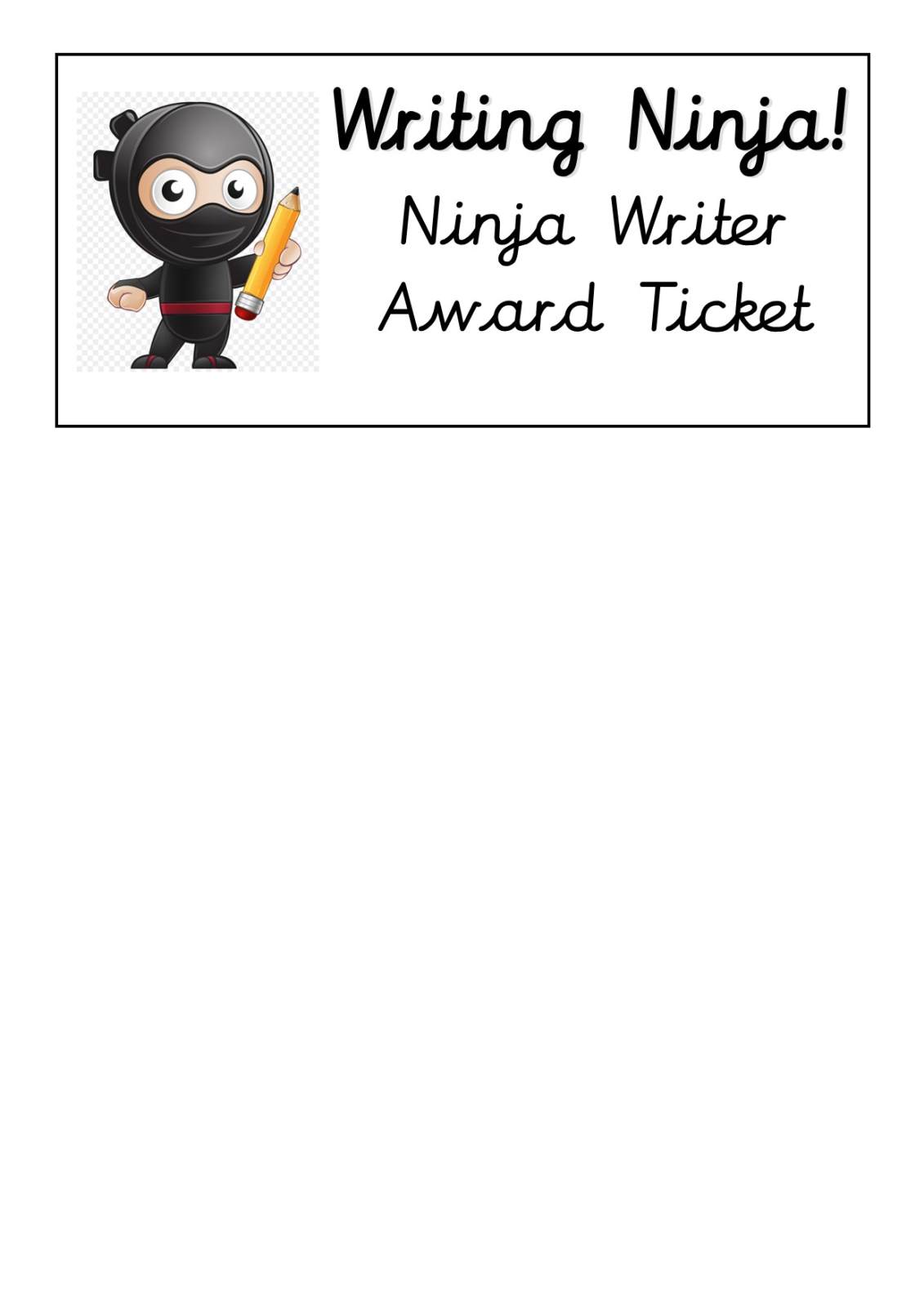
Ninja Writers
At our school, we celebrate and recognise children who demonstrate a positive attitude towards writing across the curriculum.
During writing opportunities in any curriculum subject, children have the chance to earn a Ninja Writer's Ticket. These are awarded to pupils who consistently demonstrate excellent effort, take pride in the presentation and quality of their work, meet the success criteria for the writing task they are completing, and show a commitment to improving as writers.
At the end of each half term, members of our Writing Gang randomly select one Ninja Writer's Ticket from each year group. The selected children are celebrated in assembly, receive a certificate in recognition of their achievement, and choose a fancy notebook along with a stylish pen or pencil to inspire their future writing.
By recognising writing in every subject, we encourage children to apply their writing skills across the curriculum and develop confidence, independence and pride in all aspects of their learning.
Download our Intent Statment for English